Artificial Intelligence is becoming an important part of our everyday lives. From voice assistants and chatbots to self-driving technology and movie recommendations, intelligent systems are changing how people interact with technology.
However, when exploring this field, you will frequently come across three terms: Artificial Intelligence (AI), Machine Learning (ML), and Deep Learning (DL).
Many beginners use these terms interchangeably, but they are not exactly the same.
So, what makes them different? Let's understand each concept with simple explanations and real-world examples.
1. What Is Artificial Intelligence (AI)?
Artificial Intelligence is a branch of computer science focused on creating systems that can perform tasks that normally require human intelligence.
These tasks include learning, reasoning, understanding language, recognizing images, and solving problems.
Real-world examples:
ChatGPT answering questions.
Voice assistants understanding spoken commands.
Navigation applications suggesting routes.
AI systems identifying objects in images.
The main goal of AI is to develop intelligent systems that can assist humans and solve problems.
2. What Is Machine Learning (ML)?
Machine Learning is a subset of Artificial Intelligence that allows computers to learn patterns from data and make predictions without being explicitly programmed for every situation.
Instead of manually writing instructions for every possible outcome, developers train models using data.
Real-world examples:
Email spam detection.
Movie recommendations.
Fraud detection in banking.
Predicting house prices.
For example, an email filtering system can learn patterns from previously labelled spam and legitimate messages to classify new emails.
3. What Is Deep Learning (DL)?
Deep Learning is a specialized subset of Machine Learning that uses artificial neural networks with multiple layers to learn complex patterns from large datasets.
It is particularly useful for working with images, speech, video, and natural language.
Real-world examples:
Facial recognition.
Voice recognition.
Self-driving vehicle perception.
Advanced language models.
Image generation systems.
Deep Learning models can learn complex features automatically, although they often require substantial computing resources and suitable training data.
4. AI vs ML vs Deep Learning: Key Differences
FeatureAIMachine LearningDeep LearningMeaningIntelligent computer systemsLearning from dataLearning through deep neural networksScopeBroadest conceptSubset of AISubset of MLData requirementDepends on approachUsually requires dataOften requires large datasetsTechniquesRules, search, ML and othersStatistical learning algorithmsMulti-layer neural networksExampleRule-based virtual assistantSpam detectionFacial recognition
5. How Are These Technologies Connected?
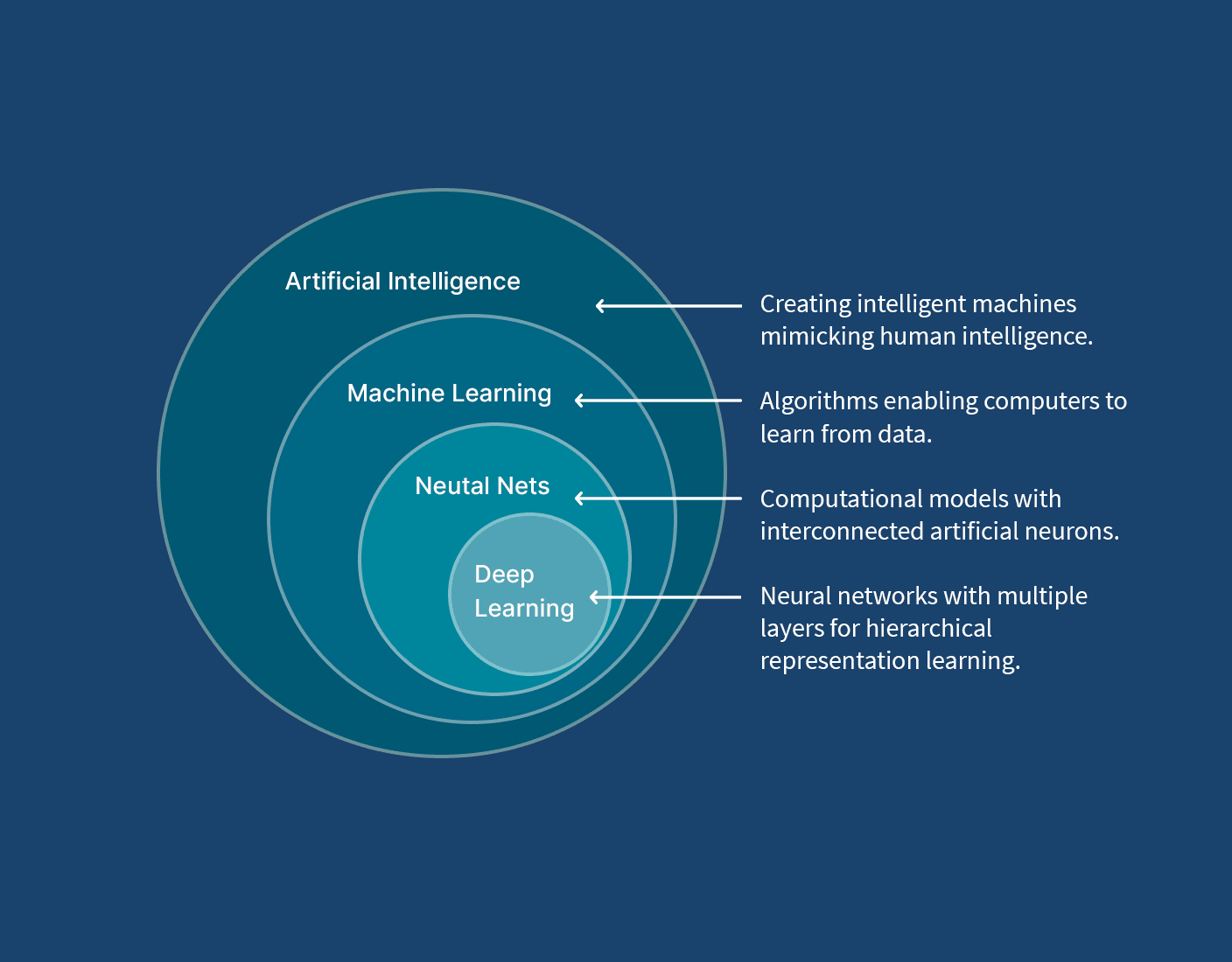
The easiest way to understand their relationship is to imagine three circles.
Artificial Intelligence is the largest circle. Machine Learning exists inside AI, and Deep Learning exists inside Machine Learning.
This means:
All Deep Learning is Machine Learning.
All Machine Learning is part of Artificial Intelligence.
Not all AI systems use Machine Learning.
Not all Machine Learning systems use Deep Learning.
6. Where Are These Technologies Used?
These technologies are applied across different industries.
Healthcare: AI assists with medical image analysis, while ML and Deep Learning can help identify patterns in medical data.
Education: AI supports personalized learning, automated assistance, and educational applications.
Banking: ML models help identify suspicious transaction patterns and support fraud detection.
Entertainment: Recommendation systems help users discover movies, music, and videos.
Transportation: Deep Learning supports image recognition and object detection in advanced driver-assistance systems.
7. Which One Should Beginners Learn First?
If you are a student or beginner, start with the fundamentals of Artificial Intelligence.
Follow this learning path:
Understand basic AI concepts.
Learn Python programming.
Explore mathematics and statistics.
Study Machine Learning fundamentals.
Practice using datasets and ML algorithms.
Explore neural networks and Deep Learning.
Build practical AI projects.
You can use Python libraries such as NumPy, Pandas, Scikit-learn, TensorFlow, and PyTorch as you progress.
8. Career Opportunities in AI, ML, and Deep Learning
Students interested in these technologies can explore career paths such as:
Artificial Intelligence Engineer.
Machine Learning Engineer.
Deep Learning Engineer.
Data Scientist.
Computer Vision Engineer.
Natural Language Processing Engineer.
AI Application Developer.
The skills and qualifications required vary depending on the role and organization.
Final Thoughts
Artificial Intelligence, Machine Learning, and Deep Learning are closely connected technologies, but each has a different purpose and scope.
Understanding these differences is an important first step for anyone interested in exploring modern technology.
You don't need to learn everything at once. Start with AI fundamentals, develop your programming knowledge, and gradually explore Machine Learning and Deep Learning through practical projects.
At AIVASU, we believe that understanding technology is the first step towards creating it.
Learn the concepts, experiment with real-world applications, and start building your future in Artificial Intelligence.
Learn AI. Explore ML. Create the Future with AIVASU.