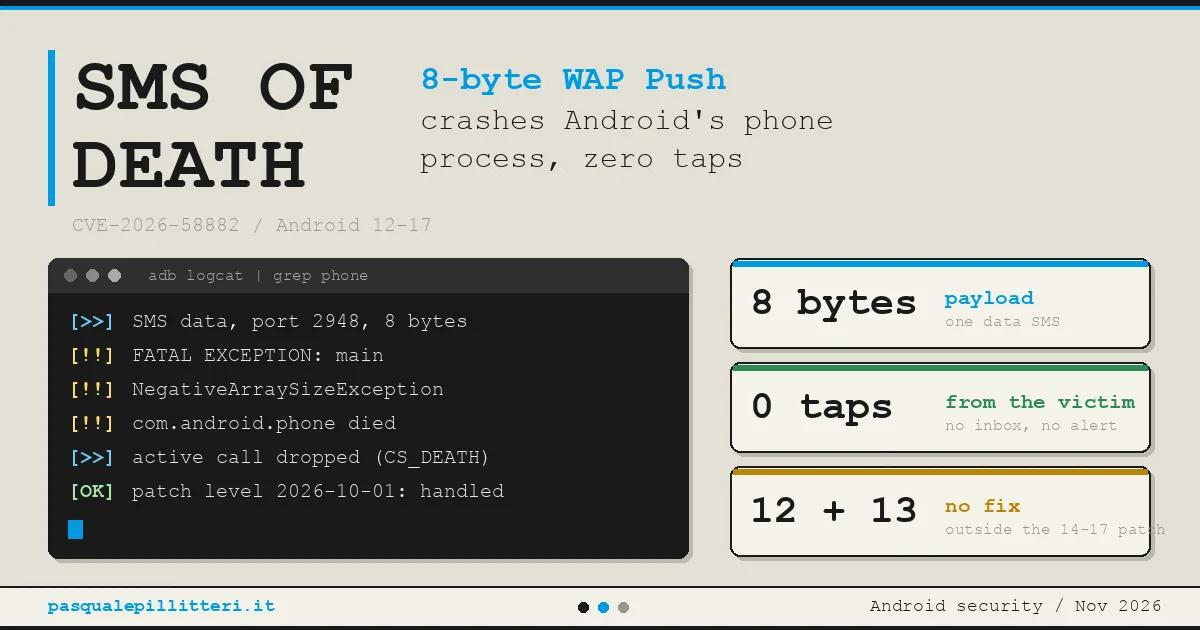
A critical security flaw has exposed the lingering vulnerabilities within mobile telecommunications. Designated CVE-2026-58882—and dubbed the modern Android "SMS of Death"—this vulnerability allows a remote, unauthenticated attacker to instantly sever cellular connectivity or trap a victim's smartphone in an endless reboot loop. All that is required to execute the attack is the target's phone number.
This zero-click vulnerability requires no user interaction, leaves no trace in the SMS inbox, and poses a severe threat to mobile device availability.
The Technical Architecture: Anatomy of an 8-Byte Exploit
At the core of CVE-2026-58882 is a single, malformed 8-byte WAP Push message. WAP Push is a legacy carrier technology built to silently push operational payloads—such as MMS connection profiles or network configuration updates—directly to a mobile device over UDP port 2948 without prompting the user.
[ Attacker ] ---> (8-Byte Malformed WAP Push SMS) ---> [ Target Device ]
                                                             |
                                           [ Telephony Framework: WapPushOverSms ]
                                                             |
                                            (Header Length Conversion Error)
                                                             |
                                          [ Signed Integer: -2,147,483,648 ]
                                                             |
                                         [ NegativeArraySizeException Triggered ]
                                                             |
                                            [ com.android.phone Process Crashes ]
The flaw sits deep within Android’s core telephony framework, inside the WapPushOverSms.decodeWapPdu function. When processing the inbound data packet, the parser encounters a fatal logic error during header-length validation:
Integer Wrap: The system parses the numerical header length and converts it into a signed 32-bit integer. Due to missing size checks, the value flips into a negative integer (
-2,147,483,648).Fatal Exception: Passing a negative length into internal array allocation procedures causes the runtime to throw a fatal
NegativeArraySizeException.Service Termination: The unhandled exception instantly crashes the core process
com.android.phone. Because this background daemon handles cellular radios, active voice calls (including emergency calls) immediately drop, and network connectivity vanishes for 1 to 2 seconds until the process auto-restarts.
The Boot Loop Trap & Carrier Redelivery Amplification
While a single 8-byte message drops calls and resets cellular radios temporarily, sending roughly 20 consecutive messages turns a mild nuisance into a bricked phone.
+-------------------------------------------------------------------------+
|                        The Denial-of-Service Cycle                      |
+-------------------------------------------------------------------------+
| 1. Malformed WAP Push message arrives at the device.                    |
| 2. Core framework attempts parsing -> NegativeArraySizeException.       |
| 3. com.android.phone crashes BEFORE returning an acknowledgment (ACK). |
| 4. Carrier cell towers register a delivery failure and auto-resend.    |
| 5. System queues payload locally; re-processing on boot causes crash.   |
+-------------------------------------------------------------------------+
Because com.android.phone terminates mid-execution, the OS never sends a formal Delivery Acknowledgment (ACK) signal back to the carrier's Short Message Service Center (SMSC). Interpreting this as a network drop, the carrier automatically re-transmits the poison payload.
Simultaneously, the OS queues the unparsed payload locally. When the device reboots, it attempts to parse the payload again upon startup, instantly triggering another NegativeArraySizeException. This traps the smartphone in a continuous reboot loop that cannot be resolved through normal UI interactions.
Vulnerability Scope: Patch Availability & OS Fragmentation
Google addressed CVE-2026-58882 in the October 2026 Android Security Bulletin. However, patch distribution highlights ongoing issues with Android OS fragmentation:
Android VersionVulnerability StatusFix StatusAndroid 14 to 17AffectedPatched via October 2026 Security UpdateAndroid 12 & 13AffectedUnpatched (End-of-Life; No official vendor patch)Legacy Systems (< Android 12)Varies by VendorUnpatched
Devices running Android 12 and 13 will not receive an official patch from Google or OEMs. Millions of legacy devices remain permanently vulnerable to remote denial-of-service exploits over the air unless protected by custom downstream ROMs (e.g., GrapheneOS).
Mitigation & Recovery Steps
For devices caught in an infinite boot loop from CVE-2026-58882, traditional user troubleshooting is often ineffective. System administrators and power users can use the following methods to mitigate or recover:
Apply Security Updates: Update supported hardware (Android 14+) to the October 2026 security patch level or higher immediately.
ADB Telephony Cleanup (Recovery without Wipe): If caught in a crash loop, connect the device to a workstation via Android Debug Bridge (ADB) during the small boot window. Execute commands to clear stored telephony databases (
/data/user_de/0/com.android.providers.telephony/databases/) to remove queued payloads before the process crashes.Hard Factory Reset: If ADB access is unavailable or disabled, performing a hard factory reset through the hardware recovery menu is the only remaining way to clear the local queue.
Carrier-Level Filtering: Enterprise mobile deployments should request WAP Push PDU filtering at the carrier level to drop unsolicited data packets over port 2948.